How I Got Into Magic Twice, and Why Staying Is Harder Than Starting
I’ll start with the nice part, because it’s true. Getting into Magic: The Gathering was one of the easiest things I’ve done in any hobby, and I’ve tried a lot of them. Woodworking, aquariums, books, computers and software. I go from one to the next. Magic is the one that kept pulling me back, and I want to explain why it worked on me, and why I think the hobby is better at getting people in than at keeping them.
The first try didn’t take
My first look at Magic was in middle school. A friend’s parents played, and I got a bunch of their cards as a treat for cleaning up and doing chores for them. They’d built the cards into a deck for me. I tried to play. I didn’t understand it, so I put it away and moved on with my life.
Magic is hard to learn from a stack of cards. I’d guess a lot of people have had that same first try, and a lot of them never get a second one.
The rabbit hole
Years later, Magic found me again through YouTube, the way a lot of people find things now. I watched a video from Tolarian Community College, a channel hosted by a character who calls himself the Professor. He was giving his opinion on a new product release and going through the cards, and I got excited. Part of it was the cards. Part of it was the idea that a box could return its value, and I thought, I can do that too. That was my thinking at the time, and I’m not here to tell anyone what a box is worth.
The channel also showed me the bigger Magic community on YouTube, and that built the hype for something I wanted to experience for myself. I was also looking for a way to meet people, to get out of the house, to have friends and something to do. Magic looked like it could be all of that.
The front door, done right
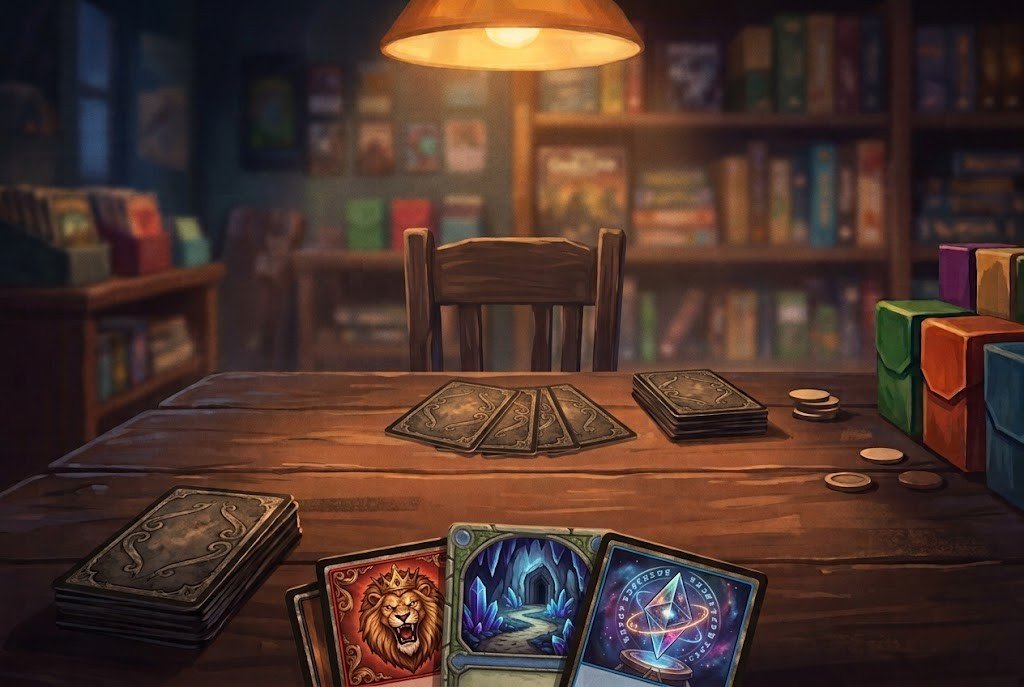
I went to our local game store, Cosmic Castle. They carry Magic, Pokémon, Yu-Gi-Oh and board games. I walked in expecting to spend money, and I didn’t have to spend a dime on Magic to get started. They had beginner decks and they teach the game for free. Another player there was willing to teach me, so we played a couple of games on the easy beginner decks. The mechanics made sense this time. I understood how it worked, and I got excited.
I want to be exact about this, because it’s the best part of the story. Nothing about that first day was a sales pitch. A store had a deck on the shelf and a person had some time. Wizards of the Coast describes Friday Night Magic as a weekly in-store event for everyone from new players to seasoned veterans, and the format is whatever the store’s community enjoys. In my case, the hobby did what it says it does.
Where the bill starts
After my training session I learned the store ran Friday Night Magic with Standard decks. Standard is built from recent sets. Only cards from roughly the last three years are legal, and the oldest sets leave on a schedule. I made a few trial decks and did pretty well. But like most people, I don’t have time to research the best card in the best slot for the best mana cost, so I fell into MTG Goldfish, TCG Trader and all the rest. Tell me the deck, tell me what to buy, what to sleeve, what to play. That worked for a while. I began to win, and I enjoyed it. It was something to do.
The catch is that the treadmill is built into the format. Star City Games reports that the next rotation is February 2027, when the oldest six sets leave Standard: Wilds of Eldraine, The Lost Caverns of Ixalan, Murders at Karlov Manor, Outlaws of Thunder Junction, Bloomburrow and Duskmourn. Anyone holding a deck built on those cards has to rebuild it for the format. As the cost of keeping up went up, I couldn’t keep spending money on Standard to stay competitive. So I switched to Commander.
For the price side of this, see our earlier piece, Magic Is Still Great. Keeping Up With It Is the Hard Part.
Commander, and the table problem
Commander is an eternal format, which means you can use any card from any release that isn’t banned. It’s singleton, so you get one copy of each card unless the card specifically says you can have more. You play in a pod of players, each built around their own commander. That’s fun too, if you can find decks near the level of yours.
Players talk about deck power on a scale of one to ten, with ten the most competitive. What I found is that people have a hard time playing at the lower end of that scale, because they want to win. They’ll often bring a higher-level deck to a table of newer players just to show they can. In my experience, that took the fun out of Magic for me. I’m not going to name anyone, and I’m not saying everyone does it. I’m saying it happened often enough at my table that I noticed.
What frustrates me is that Wizards already built a tool for this. In February 2025, Wizards and the Commander Format Panel introduced Commander Brackets: five levels, from Exhibition up to cEDH, plus a list of Game Changers, the cards powerful enough to warp a game. The stated goal is shared language, so players can match up with decks like theirs without arguing over a number. As of the panel’s February 2026 update, the system is still labeled beta.
A tool only works if people use it. A bracket doesn’t stop someone from bringing a stronger deck to prove a point. It only gives the table a way to say out loud what it expects.
Teaching my daughter
I took Magic home and began to teach my daughter. She enjoyed it. We played a couple of nights at the castle. That’s the version of the hobby I want to keep: someone patient across the table, a deck at the right level, and nobody trying to prove anything.
I don’t get to play as much as I’d like. Life changes, work responsibilities and going back to college saw to that. I still keep up with the market, I still look at the new sets and cards, and I still look for ways to get back into competitive play.
What the hobby should do differently
Magic is good at the front door. A free beginner deck and a person willing to teach got me in without costing a dime, and that deserves to be said plainly. The trouble is the next room. Here’s what I’d like to see.
Make the bracket talk the default. Ask “what bracket is your deck?” before a pod sits down, and have stores label their Commander tables by bracket the way they label events by format. Since stores choose the format for their own Friday Night Magic, a lower-power Commander night next to the Standard one is something a store can already do.
Keep teaching after the first game. The free hour that got me in was great. The hobby needs an equally easy second step for people who know the rules but can’t afford to chase Standard every few months.
Say what rotates before people buy. Stores, price sites and videos that tell a new player what to buy should also tell them when those cards leave Standard.
I got into Magic twice. The first time I didn’t understand it. The second time somebody sat down and taught me, and it stuck. If the hobby wants to keep more people, it should copy whatever that stranger did, and keep doing it after the first game.
Shop this: Magic: The Gathering Foundations Starter Collection