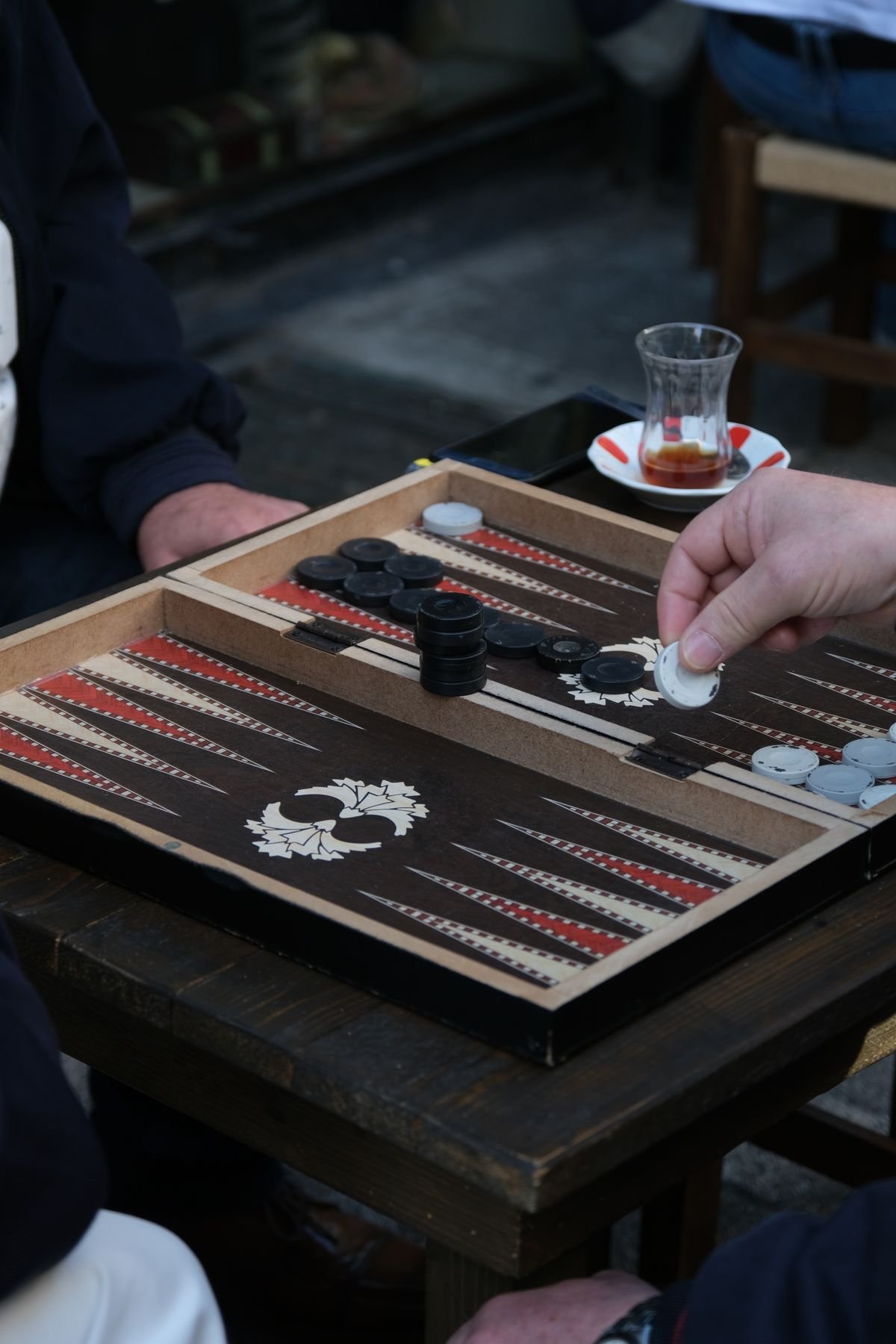
Backgammon Is 5,000 Years Old, My Son Is 9, and We’re Both Obsessed
I bought my first backgammon board a few weeks ago on what I can only describe as a whim — the kind of impulse purchase you make at 11 p.m. and then have to justify to yourself the next morning. What I did not expect was to fall down a rabbit hole that goes back roughly five thousand years, or to end up teaching the game to my nine-year-old, who now insists on rolling the dice himself “for luck” before every single move.
Turns out that’s a very old tradition. People have been blaming the dice for their mistakes since before writing was fully invented.
A Game Older Than Almost Anything Else on Your Shelf
Chess gets a lot of credit for being the ancient, cerebral board game. Backgammon was there first, and it wasn’t close. Archaeologists have pulled race-and-dice games out of the ground in Mesopotamia dating back to roughly 3000 BCE, including the famous Royal Game of Ur boards unearthed by Leonard Woolley in the 1920s — not backgammon exactly, but unmistakably its great-great-grandparent. The Egyptians had their own version called Senet, which shows up painted on tomb walls and buried alongside pharaohs, presumably so they’d have something to do in the afterlife besides being mummified.
The game that plays almost exactly like modern backgammon shows up in Persia under the name Nard, sometime around the 3rd to 6th century CE. There’s a legend — probably more folklore than fact, but a good story regardless — that a Persian sage invented Nard specifically as a rival to chess, arguing that a game ruled partly by chance says more about real life than one of pure calculation. I find that a pretty compelling defense every time my son rolls double sixes and undoes twenty minutes of my careful planning.
The Romans played their own variant called Tabula, and by most accounts they were obsessed with it. Emperor Claudius reportedly played while riding in his carriage and supposedly wrote a book on dice strategy, which tells you everything you need to know about how seriously Rome’s elite took a board game.
Banned by Kings, Played Anyway
Backgammon’s ancestors spent a good chunk of the Middle Ages under “Tables” in England and Europe, and a good chunk of that time being formally banned. Gambling was the issue, not the gameplay — both church authorities and royal decrees periodically outlawed it because people kept wagering away money, land, and, in a few memorable historical accounts, their own clothing. None of that stopped anyone from playing. It just meant tavern owners occasionally had to hide the boards.
The name “backgammon” itself first shows up in English print around 1645, most likely from “back” plus an old word for game, referring to pieces getting sent back to start — the single most infuriating part of the game then and now. By 1743, Edmond Hoyle (the same Hoyle whose name is still on rulebooks today) published a formal treatise on backgammon strategy, effectively standardizing how the modern game is played.
The Little Cube That Changed Everything
If you’ve seen a backgammon set and wondered what that oversized die with just the numbers 2, 4, 8, 16, 32, and 64 on it is for, that’s the doubling cube — and it’s the single most important invention in the game’s modern history. It showed up in New York private clubs sometime in the 1920s; nobody is entirely sure who invented it, which is a little remarkable for something that changed the entire strategic character of the game. Instead of playing one fixed-stakes game, either player can now offer to double the stakes mid-game, forcing their opponent to either accept the higher pressure or concede immediately. It turned backgammon from a pleasant pastime into a genuine psychological duel.
That innovation helped set off backgammon’s golden age. In 1964, Russian prince and New York socialite Alexis Obolensky organized the first World Backgammon Championship in Nassau, the Bahamas, and the game exploded into high society. Playboy Clubs installed backgammon rooms. Lucille Ball reportedly played obsessively. By the 1970s it was the board game of the jet set, showing up at private clubs from New York to Monte Carlo, often for stakes that would make a modern poker player blink.
Then Computers Got Involved
Here’s where backgammon quietly became one of the more important games in the history of artificial intelligence. In 1979, a program called BKG 9.8, built by Carnegie Mellon researcher Hans Berliner, beat the reigning world champion Luigi Villa in an exhibition match — largely credited as the first time a computer beat a human world champion at any board game, chess included. In the 1990s, IBM researcher Gerald Tesauro built TD-Gammon, a neural network that taught itself to play by competing against copies of itself millions of times. It didn’t just get good — it discovered opening strategies that human experts had been playing wrong for decades, and top players changed how they opened games because of what the machine figured out.
Today, tools like GNU Backgammon and eXtreme Gammon let anyone run a “rollout” on any position and see, in cold hard equity, exactly how badly they misplayed a move. It’s humbling. It’s also exactly why serious backgammon players train the way chess players do now — against a machine that has already solved most of what they’re trying to figure out.
Backgammon Right Now
Backgammon never fully went away, but it’s having a real moment again. Part of it is the broader board-game boom of the last several years. Part of it is a specific aesthetic trend — beautifully made leather and lacquered boards showing up as coffee-table objects in design magazines and on social media, next to the same renewed interest that’s pulled mahjong back into the spotlight. And part of it is simply that a game you can genuinely learn in twenty minutes but spend a lifetime getting better at is exactly the kind of thing people are craving after years of scrolling past shorter and shorter content.
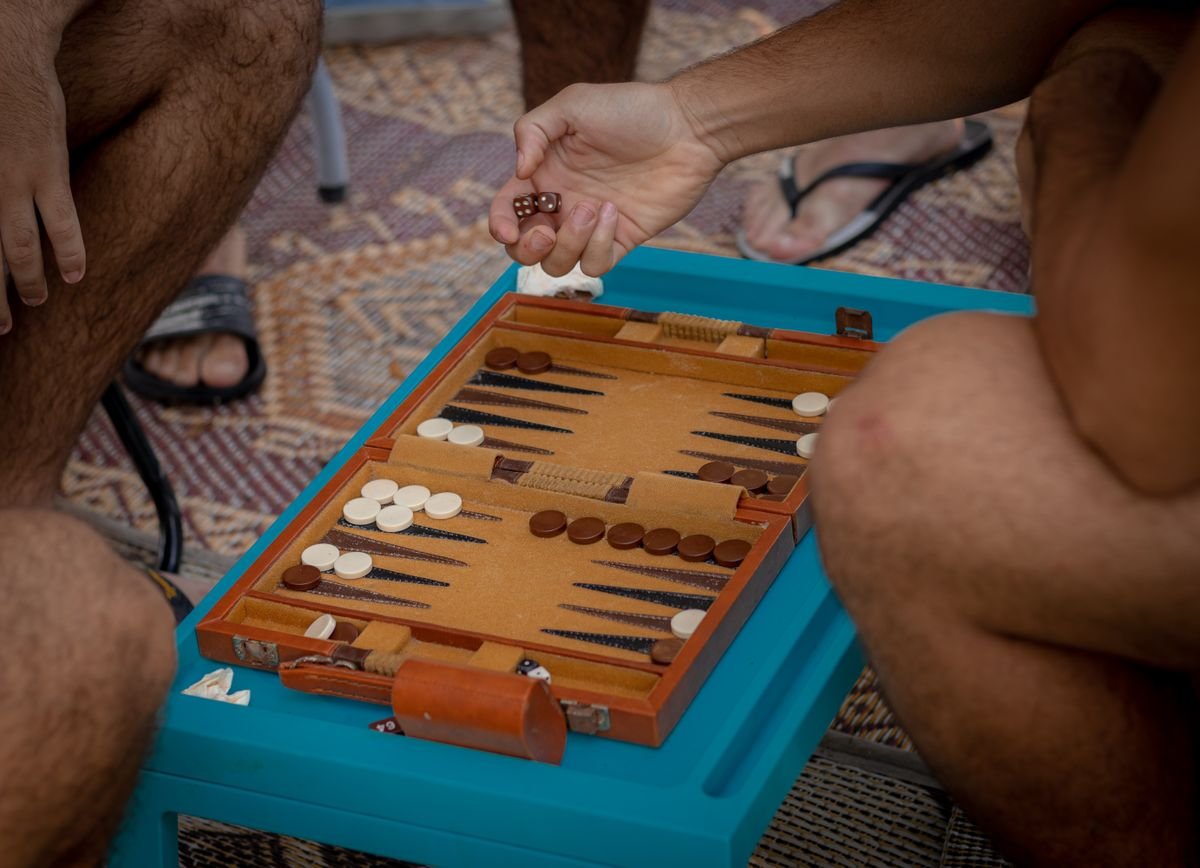
Organized play is alive and well too. The U.S. Backgammon Federation runs a national ratings system and sanctions tournaments all over the country, and the sport’s biggest annual stage is still the Monte Carlo World Backgammon Championship, a direct descendant of that 1964 Obolensky tournament and still one of the most prestigious titles in the game. Local clubs exist in most major U.S. cities and plenty of smaller ones — the USBGF’s club finder lists hundreds of them by state, including a good number that specifically welcome families and newer players, not just competitive grinders chasing rating points.
Teaching a Nine-Year-Old the Basics
I’ll admit I went in expecting to explain the rules once and then spend a few weeks quietly beating him while he got the hang of it. That is not what happened. Backgammon has just enough randomness baked in — both players roll dice every single turn — that a kid who has played it four times can absolutely wreck a parent who’s been reading about it for a month. Chess punishes beginners relentlessly. Backgammon is far more forgiving of a nine-year-old who occasionally moves a checker in the wrong direction and gets bailed out by a lucky roll two turns later.
What’s worked for us: start with just moving checkers and counting pips, skip the doubling cube entirely for the first several games, and let him win a few early on purely on the dice — not out of pity, just because that’s genuinely how the game goes sometimes, and it keeps a beginner hooked instead of discouraged. The “bearing off” endgame, where you race to get all your checkers home and off the board, is where he’s gotten genuinely competitive, mostly because it’s the part of the game that rewards paying attention over experience.
Ready to Play? Start Here
If any of this has you wanting to actually pick up a board instead of just reading about one:
Learn the rules: the USBGF’s Beginner’s Guide to Backgammon and New to Backgammon pages are the clearest starting points I found, written for people who have genuinely never played rather than people who need a refresher.
Find a club: the USBGF also maintains a club finder and registry covering hundreds of clubs by state, including several specifically noted as family- and youth-friendly if you’re looking to do what I’m doing.
Practice online, for free: Backgammon Galaxy lets you play against bots or live opponents with no cost to get started, and Board Game Arena has a solid backgammon room alongside its huge library of other tabletop games if you want to warm up on something else between matches.
Shop this: GammonVillage 15-Inch Deluxe Backgammon Set — a solid, well-priced board to actually learn on before you decide whether you want to upgrade to something nicer.
Five thousand years is a long time for a game to stick around. Judging by how often I’m now getting challenged to “one more game” on a school night, I understand why.
Featured image: photo by Hobi Photography, via Pexels.